AI and ML infrastructure is changing the operating model for data centers. As high-density racks move deeper into production environments, the challenge is no longer just selecting liquid cooling hardware. The real challenge is keeping that thermal system validated, monitored, maintained, and chemically stable across its lifecycle.
Liquid cooling adoption is accelerating because AI and HPC workloads are pushing higher rack densities, and market analysts project strong growth for data center liquid cooling through the next decade. One current market estimate value the sector at $4.8B in 2025 and projects it to reach $27.1B by 2035, driven by AI accelerators, higher-density racks, sustainability requirements, and the shift from air to liquid cooling architectures.
Industry initiatives such as the Open Compute Project are also helping shape how data centers think about scalable, efficient infrastructure for AI and high-density computing.
For data center operators, this creates a new operational question:
Who owns liquid cooling performance after installation?
The answer should not be improvised after the first alarm, fluid issue, leak event, or performance drift. It should be built into the operating model from day one.
Liquid Cooling Is a Lifecycle, not a One-Time Install
A liquid-cooled environment introduces new dependencies across facilities, operations, controls, fluid chemistry, and uptime management. Commissioning may prove that the system works at go-live, but long-term reliability depends on disciplined lifecycle management.
Shield by Guardian, liquid cooling services are built around that lifecycle: commissioning and validation, preventative maintenance, fluid management and remediation, rack-level leak detection, liquid cooling management, testing services, and system health analytics. Guardian’s Shield division describes its role as end-to-end liquid cooling infrastructure management for hyperscale and enterprise data centers, from initial commissioning through ongoing maintenance.
1. Commissioning & Validation: Start With Proof, Not Assumptions
Before liquid cooling systems support production AI or HPC loads, operators need confidence that the system performs as designed. Operators should also align liquid cooling procedures with recognized data center thermal guidance from ASHRAE.
That means validating pressure, flow, thermal performance, electrical readiness, flushing, filling, and startup procedures before handoff. Shield’s commissioning process includes site surveys, pressure testing, flushing, electrical verification, and thermal performance validation.
For data centers, this reduces the risk of discovering design or installation gaps after workloads are already live.
2. Preventative Maintenance: Protect Uptime Before Failures Start
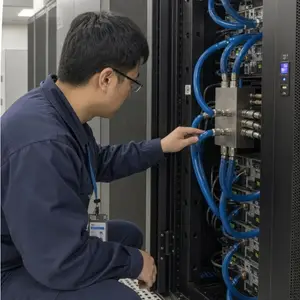
Liquid cooling systems introduce pumps, valves, heat exchangers, filters, CDUs, sensors, and control systems that need structured maintenance.
Shield’s preventative maintenance programs include scheduled inspections, pump and valve servicing, filter replacement, flushing, filling/refilling, SLA management, and proactive maintenance workflows.
The goal is simple: keep cooling systems stable before performance drift becomes an uptime issue.
3. Fluid Management & Remediation: Coolant Health Is Infrastructure Health
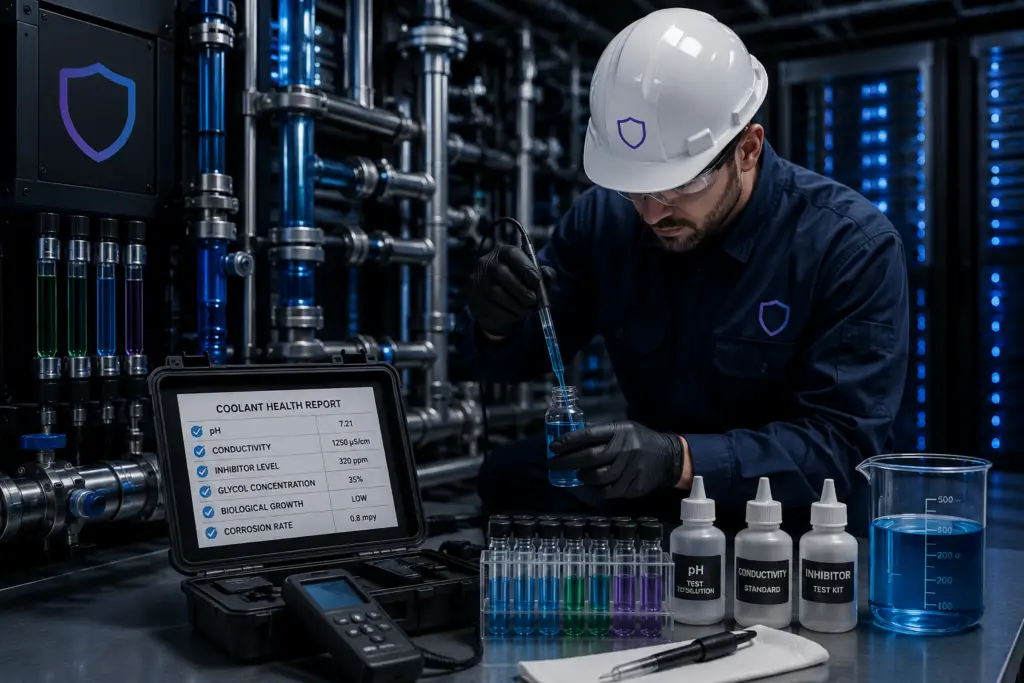
Coolant is not a static asset. It needs testing, trending, treatment, and remediation.
Shield monitors and treats cooling fluids by testing pH, conductivity, biological growth, and corrosion risk. The service model includes pH adjustment, inhibitor replenishment, glycol top-offs, system purges, and full drain-and-refill flushes.
This matters because thermal stability depends not just on mechanical design but on fluid quality over time.
4. Leak Detection & Monitoring: Find Issues Before They Become Incidents
Liquid cooling does not eliminate operational risk; it changes the type of risk operators must manage. Rack-level leak detection, fault pinpointing, BMS integration, and 24/7 monitoring become critical parts of the operating model.
Shield’s rack-level leak detection services include design, installation, and commissioning of FG-NET and FG-DLC rack-level glycol leak detection systems, BMS integration via MODBUS/JBUS, and advanced monitoring capabilities. For live environments, early detection can be the difference between a controlled maintenance event and a costly disruption.
5. Liquid Cooling Management: Keep the Whole System in Spec
Liquid cooling requires continuous attention across CDUs, flow rates, filtration, cleaning, thermal load balancing, and system health analytics.
Shield by Guardian liquid cooling management services cover CDU performance monitoring, maintenance, cleaning, filtration, flushes, thermal load balancing, flow rate optimization, and system health analytics.
This is where operators can move from reactive service to a managed thermal performance model.
What This Means for Data Center Operators
Your organization may already be planning new AI capacity, retrofitting existing halls, or validating whether current cooling infrastructure can support higher-density workloads.
A practical next step:
Assess your high-density environments. Identify AI, ML, and HPC areas where air cooling is already constrained or where future rack densities will require liquid cooling.
Validate operational readiness. Review commissioning, maintenance, fluid testing, remediation, monitoring, and emergency response workflows before production go-live.
Build a repeatable liquid cooling lifecycle program. Define how each site will commission, monitor, maintain, test, remediate, and document its liquid cooling systems.
Shield’s role is to be your liquid cooling lifecycle partner, working side by side with your facilities and operations teams to handle commissioning and validation, preventative maintenance, fluid management and remediation, leak detection, onsite monitoring, and system health analytics across your portfolio. That lets you accelerate liquid cooling adoption with a partner that understands live AI and ML data center environments, safety expectations, and operational uptime.
Which part of the liquid cooling lifecycle, commissioning, preventative maintenance, fluid management, leak detection, or monitoring, feels riskiest in your environment today?