Developed by Dr. Curtis Breville
The Next Challenge in Liquid Cooling Isn’t Deployment. It’s Retirement.
The data center industry is rapidly learning how to deploy liquid cooling.
Operators are sizing CDUs, commissioning secondary cooling loops, validating coolant chemistry, managing filtration, monitoring pressure and flow, testing leak detection, and learning how to operate increasingly dense AI infrastructure.
But another engineering challenge is approaching that receives remarkably little attention:
How do we safely remove all of this equipment when its useful life is over?
For traditional air-cooled servers, retirement is largely an IT asset disposition exercise. Power the equipment down, disconnect it, sanitize the data, remove the hardware, test or remarket what has value, and recycle the remainder.
Direct liquid cooling changes that workflow.
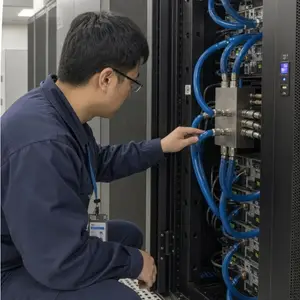
Once coolant enters cold plates, hoses, quick disconnects, rack manifolds, and facility distribution systems, retirement becomes a coordinated mechanical, environmental, and IT operation.
The last production workload is therefore not the end of the cooling life cycle.
It may be the beginning of one of its most complicated phases.
A Liquid-Cooled Server Cannot Always Simply Be Unplugged and Shipped
Consider what happens when an air-cooled server is removed from a rack.
If an ITAD provider wants to test it later, the server can often be powered in a conventional lab environment with adequate airflow.
Now consider a high-density AI server whose CPUs and GPUs were designed to operate behind liquid-cooled cold plates.
Can the ITAD provider power it up after it leaves the data center?
What cooling infrastructure will be available?
Will the original rack manifold be gone? Will the server-side hoses and QDs still be installed? What coolant will be used for testing? What flow rate, pressure, supply temperature, and coolant quality does the OEM require?
Suddenly, determining whether a $100,000+ piece of equipment still functions may require a temporary liquid-cooling environment.
That requirement alone can change the economics of asset disposition.
Organizations should determine before purchasing liquid-cooled infrastructure how the hardware will eventually be validated, remarketed, or recycled.
Getting the Coolant Out Is Not the Same as Draining a Pipe
This is where decommissioning becomes more technical than many life cycle plans currently acknowledge.
Closing a valve and opening a drain does not necessarily remove the coolant from a liquid-cooled rack.
Fluid can remain trapped in:
- cold-plate microchannels;
- server hoses;
- vertical and horizontal manifolds;
- low points in distribution piping;
- filters and strainers;
- heat exchangers;
- pumps;
- valves; and
- sections isolated by closed quick disconnects.
A rack that appears drained may still contain a meaningful volume of liquid distributed across dozens of servers.
That matters when equipment is tilted, transported, disassembled, or shipped to an ITAD facility.
A few gallons of coolant spread throughout a rack may sound insignificant until that coolant ends up on a data hall floor, inside shipping materials, in a truck, or on an ITAD technician’s workbench.
Complete recovery may therefore require not only gravity draining but also a controlled purge procedure.
Depending on OEM requirements, that might involve clean, dry air or dry nitrogen introduced at a controlled pressure to push residual coolant toward a closed recovery vessel.
But purging creates another engineering requirement:
What is the maximum pressure the cold plates, hoses, manifolds, and QDs can safely tolerate?
The objective is to remove fluid, not turn a cold plate into a pressure vessel.
Purge pressure, connection points, outlet routing, pressure relief, recovery containers, and fluid containment should all be defined before anyone starts disconnecting racks.
Coolant Has a Chain of Custody Too
One of the mistakes the industry could make is treating recovered coolant as though all liquid-cooling fluids are interchangeable.
They are not.
Two systems may both be described as using “PG25,” for example, while containing different inhibitor packages, additives, water quality, or contamination histories.
Recovered coolant may also contain particulates, corrosion products, biological contamination, or chemistry changes that developed during operation.
Before fluids from different systems are combined, operators should know:
What exactly is this fluid? Where did it come from? What condition is it in? Can it be reused? Does it require treatment? How will it be transported or disposed of?
In some cases, sampling the coolant before decommissioning begins may be more valuable than analyzing a mixed drum after twenty racks have been drained into it.
Fluid identity and condition become part of the equipment’s retirement documentation.
For dielectric immersion or two-phase systems, the environmental, handling, and recovery considerations can be even more significant.
Coolant management does not end when compute stops.
The Rack May Be Leaving. The Cooling System May Not Be.
Large deployments introduce another complication: systems are rarely retired all at once.
Imagine a hall containing 100 liquid-cooled racks connected to shared secondary fluid infrastructure.
Twenty-four racks are being removed.
What happens hydraulically to the remaining seventy-six?
Removing racks changes system flow, pressure drop, and potentially pump operating points. Branches must be isolated correctly. Dead legs should be avoided or managed. Control logic may need new setpoints. Pump speeds may need adjustment. Manifold sections may need to remain filled, drained, or capped depending on future use.
And throughout the process, the remaining production equipment still needs reliable cooling.
This means decommissioning cannot be treated as an isolated IT project.
The CDU, pumps, valves, controls, BMS/BAS, facility water system, and remaining technology cooling system may all need to continue operating while portions of the environment are being dismantled.
That is why I describe liquid-cooling retirement as a multidisciplinary engineering event, not simply an ITAD activity.
Design for Retirement on Day 0
Perhaps the most important lesson is that decommissioning should influence the original system design.
Ask during procurement:
Where are the drain points?
Where are the purge connections?
Can individual racks be isolated without disrupting adjacent equipment?
Are there low-point drains?
Can trapped fluid be recovered?
What type of QDs are being used, and what fluid remains trapped when they close?
How will temporary cooling be provided if servers require functional validation after removal?
What is the procedure for recovering, identifying, and transporting coolant?
Can the CDU continue operating efficiently as large portions of its original load disappear?
What happens when the last rack is gone?
These sound like retirement questions.
They are actually Day 0 design questions.
A system designed only around getting coolant into equipment may prove surprisingly difficult to empty five years later.
Every Liquid-Cooling Deployment Has Two Engineered Transitions
The industry puts enormous effort into commissioning because we recognize that bringing a cooling system into production requires controlled procedures, documentation, testing, and verification.
We should begin applying the same discipline at the other end of its life.
A liquid-cooling system effectively has two engineered transitions:
The day it enters service and the day it leaves service.
The first validates that coolant can be introduced safely, pumps can operate correctly, heat can be removed, chemistry is acceptable, and the system can support production.
The second must validate something very different: that equipment can be isolated, coolant recovered, production systems protected, assets safely removed, residual fluids managed, and infrastructure left in a known condition.
Decommissioning is therefore not simply commissioning performed backward.
The risk profile is different.
The AI Refresh Cycle Will Make This Urgent
Most organizations have not yet faced liquid-cooling retirement at scale because most of today’s high-density AI deployments are still relatively new.
That will change.
AI infrastructure refresh cycles will eventually place thousands of liquid-cooled servers into retirement simultaneously.
At that point, questions currently handled rack by rack become operational programs:
Who owns coolant recovery?
Who supplies the purge equipment?
Who provides temporary cooling for hardware validation?
Who certifies that equipment is sufficiently drained for transport?
Who documents recovered fluid?
Who reconnects hardware at the ITAD facility?
Who is responsible if coolant leaks during transportation?
And what portions of the facility cooling infrastructure remain valuable after the compute equipment is gone?
The organizations that answer those questions now will have a considerable advantage when the first large-scale liquid-cooled refresh cycles arrive.
Shield’s Perspective
At Shield by Guardian, we view commissioning, coolant health, maintenance, remediation, leak response, and decommissioning as connected parts of one liquid-cooling life cycle.
The objective is not simply to keep coolant flowing while equipment is in production.
It is to understand and manage what is happening to the cooling system from the first fill to the final drain.
That means end-of-life planning should begin long before the end of life.
Operators deploying liquid cooling today should already be asking how racks will eventually be isolated, drained, purged, validated, removed, and replaced without compromising the remaining environment.
Because the next major liquid-cooling challenge may not be getting coolant into millions of AI servers.
It may be figuring out how to safely get all of it back out.
Infrastructure retirement is not the final chapter of a liquid-cooling project. It is one of the original engineering requirements.