A direct liquid cooling system can be mechanically complete without being operationally ready.
The piping may be installed. The coolant distribution units (CDUs) may be connected. Cold plates and supporting infrastructure may all be in place. Coolant may even be circulating through the system.
None of those conditions, by themselves, establish that the fluid system is ready to support mission-critical IT equipment.
That distinction is why commissioning matters.
For direct liquid cooling (DLC), quality commissioning is not simply the final step in installation. It is the transition between a collection of installed components and a cooling system that operations teams can confidently place into service.
Fluid condition needs to be part of that transition.
Installation Changes the Question
During construction, teams verify that the system is installed correctly.
Commissioning planning begins earlier and continues through installation, startup, and operational handoffs, verifying that the completed system meets the owner’s requirements.
As the project approaches operational handoffs, the central question becomes:
Is the system ready to operate?
That requires looking beyond whether individual components are present and connected.
A DLC system brings together piping, CDUs, cold plates, connections, coolant, and other materials into a circulating system. Once that happens, the condition of one part of the system can affect another.
The coolant is no longer something that can be considered independently from the infrastructure around it. It is moving through the equipment, interacting with the materials in the loop, and becoming part of the operating environment.
That creates an important commissioning principle:
The condition of the fluid entering operation matters just as much as the condition of the equipment.
New Does Not Automatically Mean Clean
One of the assumptions commissioning should challenge is that a newly installed system must also be a clean system.
Installation and construction introduce opportunities for material to enter the fluid path. Components come from different sources, piping and connections are assembled in the field, and the complete system may pass through multiple stages before final startup.
Construction debris, corrosion products, and residual processing materials can restrict small fluid passages, foul heat-transfer surfaces, and impair cooling performance.
Distribution piping should be cleaned, and its cleanliness verified before sensitive equipment is connected or exposed, following the approved project sequence and manufacturer requirements.
The important operational question is not whether contamination should be present.
It is whether the condition of the system has been validated before it is handed over to operations.
Once coolant begins circulating, unwanted material in the loop can move with it. In a DLC environment containing relatively small fluid passages and critical heat-transfer components, fluid cleanliness and condition therefore become operational concerns rather than housekeeping issues.
Commissioning provides an opportunity to identify those concerns before they become part of normal operations.
The Open Compute Project has published specific guidance for pre-commission preparation of Technology Cooling System pipework, including cleaning, flushing and preparation before commissioning.
Fluid Validation Is a Critical Part of DLC Commissioning
Filling the system with the specified coolant establishes the intended fluid selection. It does not, by itself, verify the coolant’s condition after filling and circulation.
Coolant condition can be evaluated through field diagnostics, sampling and, where appropriate, laboratory analysis. The objective is not testing for the sake of producing data. It is establishing whether the fluid condition is consistent with the requirements for operational handoffs.
That distinction matters because coolant chemistry exists for engineering reasons. Fluid properties and chemistry can relate to issues such as corrosion protection, material compatibility, thermal performance, and long-term reliability.
Commissioning is therefore an important point to verify fluid condition rather than simply assume it.
The exact tests, specifications, and acceptable parameters will depend on the coolant, equipment, and applicable requirements. There is no single universal set of values that should be applied to every DLC system.
The important principle is simpler:
Fluid condition should be measured, documented, and evaluated against agreed acceptance criteria at handoffs, rather than assumed from the supplied coolant specification alone.
Direct Liquid Cooling Commissioning Has to Validate the Complete System
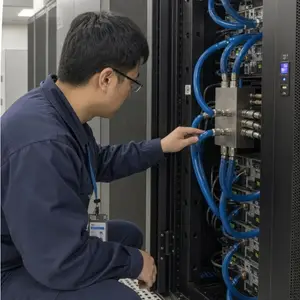
Overall readiness also requires verification of leak integrity, flow and pressure, air removal, thermal performance, controls, alarms, and the system’s response to specified operating and failure conditions. These activities are coordinated across the commissioning team, engineering team, equipment manufacturers, and operations.
Direct liquid cooling is an integrated system.
A CDU can be correctly installed. A cold plate can meet its individual requirements. Piping can be complete. The specified coolant can be delivered.
But operations inherits the complete system, not the individual pieces.
Quality commissioning should therefore help establish readiness at the system level.
That means asking whether the fluid system has been validated under the conditions required for operational handoffs and whether there are unresolved issues that should be addressed before the cooling infrastructure becomes part of normal data center operations.
This is an important difference between installation completion and commissioning.
Installation establishes that components are installed correctly.
Commissioning verifies their performance together against defined project requirements.
Commissioning Establishes the Operational Fluid Baseline
There is another reason commissioning deserves more attention: It establishes a reference condition for subsequent operation and maintenance.
Coolant condition will not remain a theoretical specification throughout the life of the system. Operators may later sample the fluid, test it, trend its condition, investigate changes, perform maintenance, or remediate problems.
Those future observations become more useful when there is a known starting condition.
A documented fluid-condition baseline should identify the coolant product and concentration, relevant quality results, sampling locations and dates, test methods, and acceptance criteria. It should also record the system configuration, relevant cleaning and filling activities, and any unresolved exceptions or required follow-up actions.
Sampling should follow a representative, documented plan. A satisfactory result from one location does not automatically demonstrate that every branch is clean or that all wetted surfaces are properly prepared.
That makes commissioning more than a startup activity.
It establishes a documented starting point for fluid management during operations.
The same fluid system will move from commissioning into operation, maintenance, testing, and eventually remediation, replacement, or decommissioning. Decisions made at the beginning can influence how effectively that lifecycle is managed later.
Outstanding issues affecting safe or reliable operation must be resolved before release to service; any accepted exceptions should have documented approval and follow-up requirements.
The Handoff Matters
Operational handoffs transfer responsibility for the accepted system to operations, even when agreed commissioning follow-up activities continue.
That makes the handoffs particularly important.
Operations teams should not inherit uncertainty about the condition of a newly commissioned fluid system. They should understand what was validated, what condition the coolant was in at startup, what documentation exists, and whether any outstanding issues require monitoring or corrective action.
The objective is not simply to demonstrate that coolant can circulate.
It is to give operations a defensible starting point for managing the system.
For mission-critical infrastructure, that is a meaningful difference.
How Shield Thinks About DLC Commissioning
At Shield by Guardian, our focus is fluid readiness and lifecycle management within the broader DLC commissioning process.
We support evaluation of coolant condition and loop cleanliness, documented sampling and testing, and the fluid-related records needed for operational handoffs.
Our work is coordinated with the owner, engineering team, commissioning authority, and equipment manufacturers.
Because the best time to understand the starting condition of a liquid cooling system is before that condition becomes an operational problem.
A system being installed tells you that construction is ending.
A system being properly commissioned should tell you operations can begin with greater confidence.
Key Takeaway
Direct liquid cooling commissioning should establish readiness against defined project requirements, rather than simply confirm installation completion.
Verified coolant condition and loop cleanliness are essential parts of that determination, alongside mechanical, hydraulic, thermal, and controls verification.
That requires looking at the coolant, the condition of the loop, and the integrated system, rather than simply confirming that components are installed and fluid is circulating.
For data center operators deploying DLC at scale, that distinction becomes increasingly important.
Installation completion is a construction milestone. Operational readiness is the commissioning objective.