A new AI deployment can have a defined cooling design and still leave critical operational questions unanswered. Which coolant is approved for the equipment? How will its condition be verified before startup? Who is responsible for monitoring the cooling loop after commissioning?
These questions matter because selecting a cooling technology is not the same as establishing a reliable cooling operation.
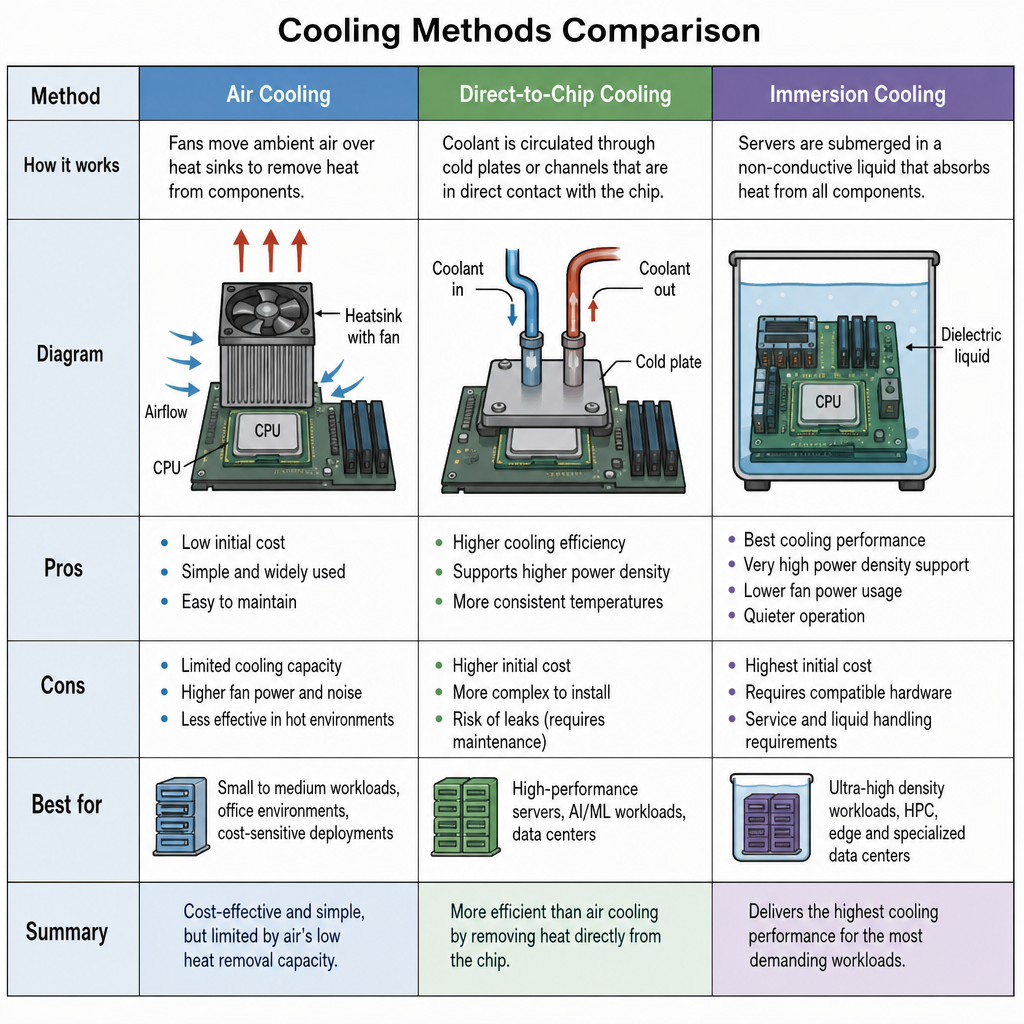
Modern data center cooling systems range from conventional air cooling to direct-to-chip and immersion technologies. Each approach changes not only how heat is removed but also how equipment is maintained, how fluids are managed, and how operational risks are controlled.
For data center operators, the goal is not simply to adopt a more capable cooling method. It is to select an architecture the facility can support, verify, maintain, and eventually retire.
Types of Data Center Cooling Systems: What Changes Operationally?
Different cooling architectures address different thermal challenges. Understanding how they remove heat is important, but so is recognizing the operating responsibilities they introduce.
1. Traditional Air Cooling
Air cooling removes heat from IT equipment through controlled airflow and facility cooling infrastructure.
Servers transfer heat to moving air, which is then cooled through systems such as computer room air handlers (CRAHs), computer room air conditioners (CRACs), or other facility cooling arrangements.
Air cooling remains appropriate for many workloads, particularly where rack densities and facility conditions allow it to operate efficiently.
The operational challenge is maintaining sufficient airflow and thermal capacity as equipment configurations change. Air management, containment, fan performance, and available cooling capacity all influence the result.
Although some air-cooling systems use chilled water within the facility, that does not mean liquid coolant circulates through the IT equipment itself. This distinction becomes important when evaluating fluid-related risks.
2. Rear-Door Heat Exchangers
Rear-door heat exchangers (RDHx) use a liquid-cooled heat exchanger positioned at the rear of a server rack to remove heat from exhaust air.
The liquid absorbs heat as warm air passes through the exchanger. Unlike direct-to-chip cooling, the liquid generally does not circulate through cold plates attached to processors.
This approach can help operators manage higher rack heat loads while retaining conventional server configurations.
However, it introduces liquid connections, heat exchanger maintenance, and additional considerations around facility water supply, access, and serviceability.
The operational question: Can the facility maintain the required liquid conditions and service the rear-door equipment without introducing unacceptable disruption?
3. Direct-to-Chip Liquid Cooling
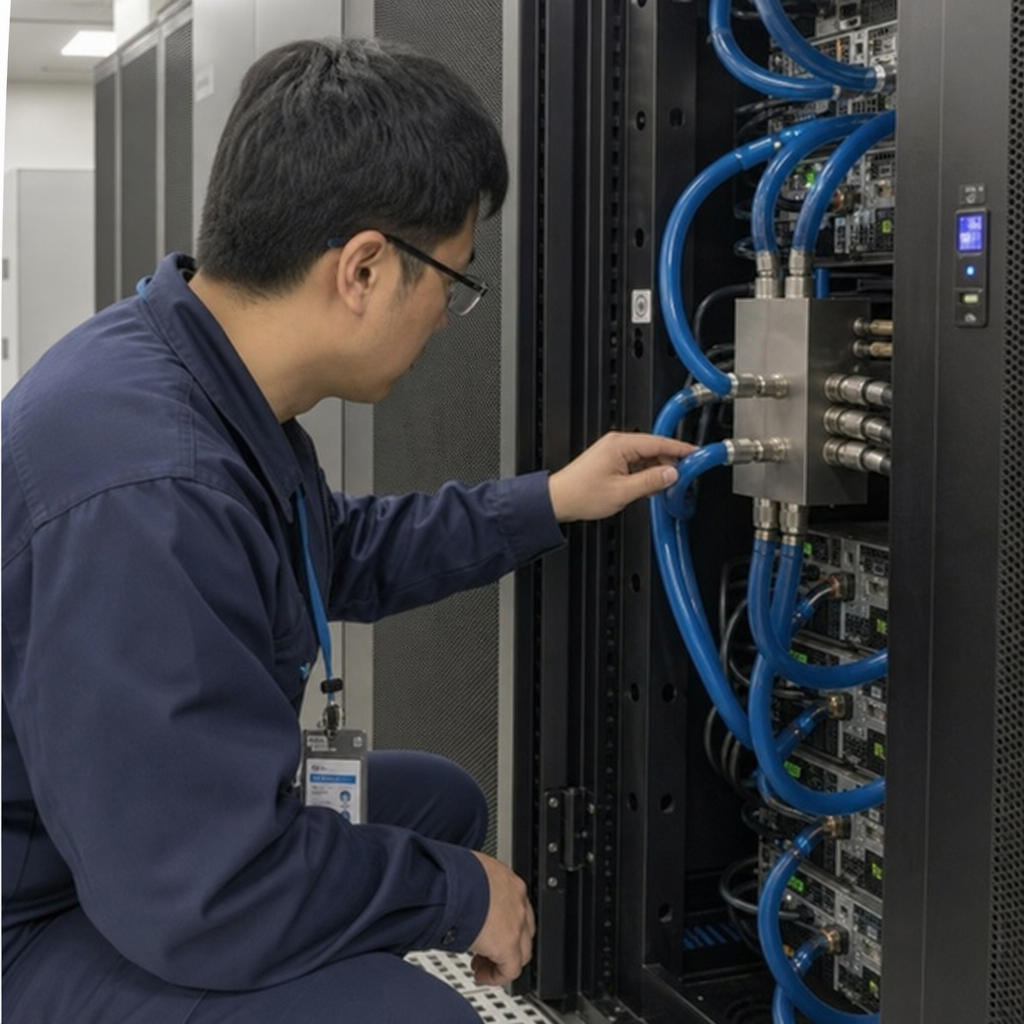
Direct-to-chip cooling circulates coolant through cold plates installed on high-heat components such as CPUs, GPUs, and accelerators.
The coolant absorbs heat from these components and transports it through a controlled loop toward the heat rejection infrastructure.
Many single-phase direct-to-chip systems use specially specified water-based or water-glycol coolants. The exact fluid requirements depend on the equipment and system design.
These fluids are selected not simply to transfer heat but also to address requirements such as material compatibility, corrosion protection, and long-term chemical stability.
Direct-to-chip cooling can coexist with air cooling because memory, power supplies, and other components may still require airflow.
For operators, the challenge extends beyond delivering coolant to the rack.
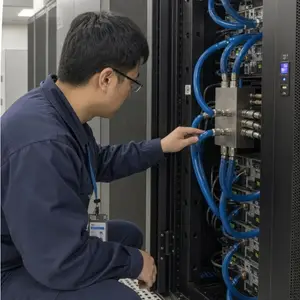
Cold plates, manifolds, hoses, quick disconnects, pumps, and associated components introduce new requirements for fluid cleanliness, connection integrity, leak detection, and maintenance.
A liquid loop can appear mechanically functional while important questions about coolant condition remain unresolved.
The operational question: Has the coolant and the technology cooling system been validated against the equipment’s requirements before the installation enters production?
4. Immersion Cooling
Immersion cooling places IT equipment in direct contact with a dielectric cooling liquid.
In single-phase immersion systems, the liquid remains in the same physical state as it absorbs heat. In two-phase immersion systems, the fluid undergoes a phase change as part of the heat-transfer process.
Unlike the water-based fluids commonly associated with single-phase direct-to-chip systems, immersion coolants are selected for electrical properties, thermal behavior, and compatibility with immersed equipment.
This changes how operators approach maintenance.
Technicians may need different procedures for accessing equipment, managing fluid carryout, evaluating material compatibility, and handling components during replacement or repair.
Immersion cooling also requires its own fluid testing and condition-monitoring strategy. Testing practices developed for water-based direct-to-chip systems should not automatically be applied to dielectric fluids.
The operational question: Can the team maintain both the fluid and the immersed hardware according to the requirements of the selected system?
Where Does Two-Phase Cooling Fit?
Two-phase cooling is not necessarily a separate category of deployment architecture.
Phase-change technology can be incorporated into certain direct-to-chip designs as well as immersion systems. It uses the energy associated with a liquid-to-vapor phase change to transfer heat.
The fluid properties, operating conditions, maintenance requirements, and handling considerations differ from those of conventional single-phase cooling loops.
Operators should therefore evaluate the specific two-phase design and its manufacturer’s requirements rather than assume that all phase-change systems operate or are maintained in the same way.
Comparing Data Center Cooling Methods: What Should Operators Verify?
The most useful comparison is not simply which technology removes the most heat. It is what evidence the operations team will need to maintain confidence in the system.
| Cooling method | Key operational consideration | Question before deployment |
|---|---|---|
| Air cooling | Airflow management and available thermal capacity | Can the facility maintain acceptable equipment inlet conditions as workloads change? |
| Rear-door heat exchangers | Liquid connections, heat exchanger condition, and service access | Are liquid supply conditions and maintenance responsibilities clearly defined? |
| Direct-to-chip cooling | Coolant chemistry, loop cleanliness, connections, and fluid monitoring | Is there a documented coolant specification and validated starting condition? |
| Immersion cooling | Dielectric fluid condition, material compatibility, and equipment handling | Are the fluid and service procedures approved for the equipment throughout its lifecycle? |
These questions illustrate why the most appropriate method depends on more than rack density.
The cooling architecture must be supported by facility infrastructure, operating procedures, manufacturer requirements, and personnel capable of maintaining it.
Data Center Liquid Cooling: The Boundary Between Facility Water and IT Coolant
One of the most important distinctions in liquid cooling systems for data centers is the relationship between the Facility Water System (FWS) and the Technology Cooling System (TCS).
The FWS provides cooling capacity from the facility infrastructure. The TCS delivers coolant to the liquid-cooled IT equipment.
In many direct liquid cooling configurations, a Coolant Distribution Unit (CDU) transfers heat between these systems through a heat exchanger while controlling conditions on the technology side. Actual arrangements vary by design.
This distinction matters because the fluids on the two sides may have different chemistry and operational requirements.
A treatment approach appropriate for facility water is not automatically appropriate for the coolant circulating through cold plates and rack manifolds.
The technology-side coolant must be compatible with the wetted materials and operating requirements of the connected equipment.
Fluid selection can influence corrosion protection, material compatibility, thermal performance, and the long-term condition of the cooling loop.
As a result, operators should establish which fluid specifications apply to each circuit, who is responsible for maintaining those specifications, and how compliance will be verified.
For a closer look at the engineering purpose of coolant components, see What’s in Liquid Coolant? Understanding the Chemistry Behind Reliable Liquid Cooling.
The important distinction is that a cooling system can meet its initial thermal objectives without that fact alone demonstrating that its coolant condition is suitable for long-term operation.
From Installation to Operations: Three Critical Fluid Management Decisions
The reliability of liquid-cooled infrastructure depends on decisions made at different points in its lifecycle.
1. Commissioning: Establish a Verified Starting Condition
Completing installation does not automatically establish operational readiness.
Before liquid-cooled IT equipment enters production, the commissioning process should provide evidence that the cooling system meets the applicable project and equipment requirements.
From a fluid management perspective, that includes verifying the approved coolant, evaluating fluid condition, and documenting relevant loop cleanliness and testing results.
Why does this matter?
Without a documented baseline, later abnormalities can be harder to interpret. Operators may discover an unexpected test result without knowing whether it represents a recent change or a condition present since startup.
Commissioning is therefore an opportunity to establish a reference point for future evaluation.
For additional operational considerations, read Direct Liquid Cooling Commissioning: Installation Complete Doesn’t Mean Operationally Ready.
2. Operations: Monitor Changes, Not Just Individual Results
Coolant condition can change during service.
In water-based direct liquid cooling systems, relevant monitoring may include pH, conductivity, inhibitor condition, particulates, and indicators of corrosion or biological activity, according to the coolant formulation and equipment requirements.
Not every parameter is appropriate for every cooling fluid. Dielectric immersion systems, for example, require different fluid-specific evaluations.
The objective is not simply to collect test results.
It is to determine whether those results indicate a condition that should change an operational decision.
A single result may have limited meaning without baseline data, fluid specifications, operating history, and other available observations.
Consider a system experiencing increased pressure differential across a filter.
Replacing the filter may address the immediate maintenance requirement. But if filter loading is changing unexpectedly, operators may also need to investigate whether fluid contamination or another condition is contributing to the trend.
The observation alone does not identify the cause. It identifies a reason to evaluate the system more closely.
This is why coolant health monitoring should connect laboratory findings, onsite observations, and maintenance records, rather than treating them as unrelated activities.
Testing intervals and acceptance criteria should be established using the applicable OEM and fluid requirements, supported by operating conditions and risk assessment. A universal testing schedule is not appropriate for every liquid cooling environment.
3. System Changes: Preserve Fluid Control Throughout the Lifecycle
Liquid cooling systems rarely remain unchanged throughout their operating life.
Servers are replaced, racks are upgraded, components are serviced, and cooling infrastructure may be expanded or reconfigured.
Each change creates questions about fluid compatibility, contamination control, documentation, and the condition of the remaining system.
For example, a fluid top-off should not be treated as a routine addition of an interchangeable liquid. The replacement fluid must be compatible with the system’s approved formulation and operating requirements.
Eventually, equipment must also be removed from service.
For liquid-cooled hardware, that may require planning for fluid recovery, system isolation, safe handling, and the ability to support equipment testing after removal.
These considerations should be addressed before retirement begins, not after the cooling connections have been disconnected.
For more on this issue, see Decommissioning Liquid-Cooled Data Center Infrastructure.
Evaluating Data Center Cooling Solutions: Six Questions That Matter Beyond Thermal Capacity
When comparing data center cooling solutions, operators should examine both the initial deployment and the requirements for sustained operation.
Before selecting or expanding a cooling architecture, ask:
- What cooling conditions does the IT equipment actually require? Identify the applicable manufacturer requirements for coolant, flow, temperature, and system integration.
- Where are the fluid boundaries and ownership responsibilities? Distinguish facility-side infrastructure from technology-side coolant management and define the handoff between teams.
- What evidence will demonstrate operational readiness? Establish how coolant condition, system cleanliness, mechanical performance, and relevant controls will be verified before production.
- What information will indicate that conditions are changing? Determine which fluid tests, system measurements, maintenance observations, and operating trends support decisions.
- What happens after a leak detection alarm? Define responsibilities for assessing and responding to an event without creating additional risks through an inappropriate intervention.
- How will the system be maintained, modified, and retired? Include fluid handling, service access, documentation, equipment changes, and eventual decommissioning in lifecycle planning.
These questions help expose the difference between a system that can be installed and one that can be operated with confidence.
A particularly important example is leak response. Detecting fluid outside its intended containment is only the beginning; the operations team must understand what the alert means and how to respond safely.
Explore this further in Why Leak Detection Is Important in Liquid-Cooled Data Centers.
How Shield by Guardian Approaches Liquid Cooling Fluid Management
Shield by Guardian approaches liquid cooling through the operational lifecycle of the fluid and the infrastructure that depends on it.
Our focus is not manufacturing cooling equipment or selecting one cooling technology over another.
It is helping data center operators manage fluid-related requirements as liquid-cooled infrastructure moves from commissioning into ongoing operation, maintenance, remediation, and eventual decommissioning.
That includes support for fluid validation, onsite diagnostics, laboratory testing, leak detection, preventive maintenance, and fluid management.
These activities serve different purposes, but they should inform a consistent understanding of system condition.
Commissioning establishes the starting point. Testing and maintenance provide information about changes. Leak detection and response planning support operational preparedness. Remediation addresses fluid conditions that require corrective attention.
For Shield, the goal is to help operators make better-informed decisions about the cooling systems they are responsible for maintaining.
The value is not in testing for its own sake. It is in understanding what the information means and how it supports operational reliability.
Frequently Asked Questions About Data Center Cooling
What are the main types of data center cooling systems?
Common approaches include traditional air cooling, rear-door heat exchangers, direct-to-chip liquid cooling, and immersion cooling. Specific liquid cooling designs may use single-phase or two-phase heat transfer. The appropriate choice depends on equipment requirements, thermal demand, facility capabilities, and the ability to support ongoing operations.
Is data center liquid cooling always more efficient than air cooling?
Not necessarily. Liquid cooling can remove heat close to high-power components and enable configurations that are difficult to support with air alone. However, total facility efficiency depends on the complete design, including pumping, airflow, heat rejection, operating temperatures, and actual workloads.
Do all liquid cooling systems require the same coolant testing?
No. Testing must reflect the coolant formulation, cooling architecture, wetted materials, and manufacturer requirements. Water-based direct-to-chip systems and dielectric immersion systems should not be assumed to share the same chemistry, acceptance criteria, or monitoring requirements.
How often should data center cooling fluid be tested?
There is no universally appropriate interval for every system. Testing frequency should consider the coolant and OEM requirements, commissioning baseline, operating conditions, system changes, and observed trends. The objective is to obtain information often enough to support informed maintenance decisions.
What is the role of a Coolant Distribution Unit?
A CDU manages coolant circulation and operating conditions within a liquid cooling arrangement. In many systems, it also transfers heat between facility water and the technology cooling loop through a heat exchanger. Its configuration and maintenance requirements depend on the system design.
The Practical Takeaway: Choose the Cooling Method and the Operating Model Together
The success of a cooling deployment should not be measured only by whether it can remove the required heat at startup.
It should also be evaluated by the evidence available at commissioning, the team’s ability to recognize changing conditions, and the procedures in place to maintain the system throughout its life.
Different data center cooling methods create different operational responsibilities. Understanding those responsibilities before deployment helps operators make decisions that extend beyond immediate thermal performance.
For facilities implementing direct-to-chip or immersion cooling, coolant condition deserves a defined place in that operating model.
A cooling system is not operationally ready simply because coolant is flowing. Readiness requires evidence that the system meets its requirements and a clear plan for maintaining that condition.
To discuss fluid readiness, testing, and lifecycle support for a liquid cooling deployment, connect with Shield by Guardian.
Industry References
- ASHRAE Handbook — Data Centers and Telecommunication Facilities
- Open Compute Project — Cooling Environments
- Open Compute Project — Cold Plate
- U.S. Department of Energy — Best Practices Guide for Energy-Efficient Data Center Design